Tone’s inline direction syntax borrows C#’s braces, so a writer can say how a word is spoken without changing the word.
A line of dialogue carries two things: what the character says, and how they say it. Scripts usually keep the second apart from the first, in a parenthetical above the line or a note in a spreadsheet column, where it drifts out of date as soon as the wording changes. Tone is designed to keep direction inside the line, in a small syntax borrowed from C#.
The pattern
The quoted part is what the character says. The part after the colon says how. Everything outside the braces stays ordinary dialogue.
{"Hey": Winded}, stop right there!Only “Hey” is out of breath. To make the whole sentence winded, you select the whole sentence. To put a breath between two words, you insert a cue of its own:
{"Hey": Winded}, {Vocalize(StealthRecovery)} stop right there!{"Hey": Winded} is shorthand for {"Hey": Say(delivery: Winded)}. You can start short and spell it out when you tune a take:
{"Hey": Say(delivery: Winded, pitch: High, rate: 0.9)}Why C#
Unity scripts are written in C#, and C# already has a way to drop a value into a string with a format after a colon: $"{distance:0.0} m". Tone borrows the shape, not the language. Braces mark the span, arguments are named, and values come from a fixed set. A writer who has never opened Unity can read Say(mode: Whisper), and a developer can see at a glance that it is data and not prose.
Cues between words
Some directions are not about how words are said but about what happens between them. A pause is a measured gap, and a vocal sound is a wordless event with a name:
Hey, {Pause(350)} stop right there!{Vocalize(StartledGasp)} What was that?{"They're close": Say(mode: Whisper)}.The vocal sounds are a short library of fourteen, each defined by what happens in the sound. A StartledGasp is one sharp inhalation. A NervousChuckle is restrained laughter, interrupted by breath.
The rules that keep it predictable
- Select the exact words. A span can be one word or a whole sentence, and its settings end at the closing brace. In
Go, {"go": Say(emphasis: Strong)}!only the second “go” is stressed. - Put sounds and silence where they belong. A delivery changes words. A
Pauseor aVocalizesits between them, and cues side by side play from left to right. - Apply settings in one order. The character’s voice comes first, then the line’s settings, then the span’s preset, then any argument you wrote out, so an explicit
rate: 0.9beats a preset’s pace. - Be strict in the language and forgiving in the editor. Commands and values are PascalCase and argument names camelCase. A duplicate or unknown value is flagged at the cue rather than guessed at.
- Keep script, captions and takes connected. The subtitle for
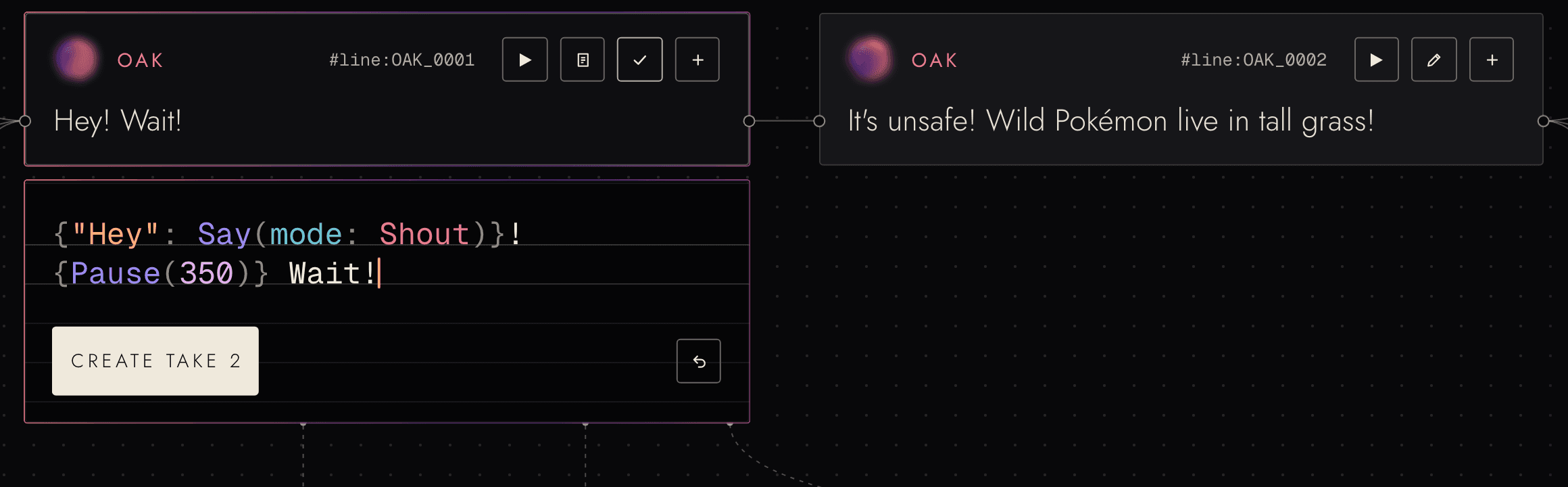
{"Hey": Winded}, {Pause(350)} stop right there!reads “Hey, stop right there!”, and an edit keeps the line’s id and makes a new candidate take.
What is designed, and what is not yet
The command names, the order of application and the timing rules are a design, not a shipped feature. Two parts of it are deliberately cautious. A Pause(350) is designed to be a gap Tone places and then checks in the rendered audio. Where a voice can only approximate a direction, Tone is designed to say so at the cue, before anything is generated. Every voice still has to be auditioned to learn which directions it can carry.
Comments